The Central Paradox
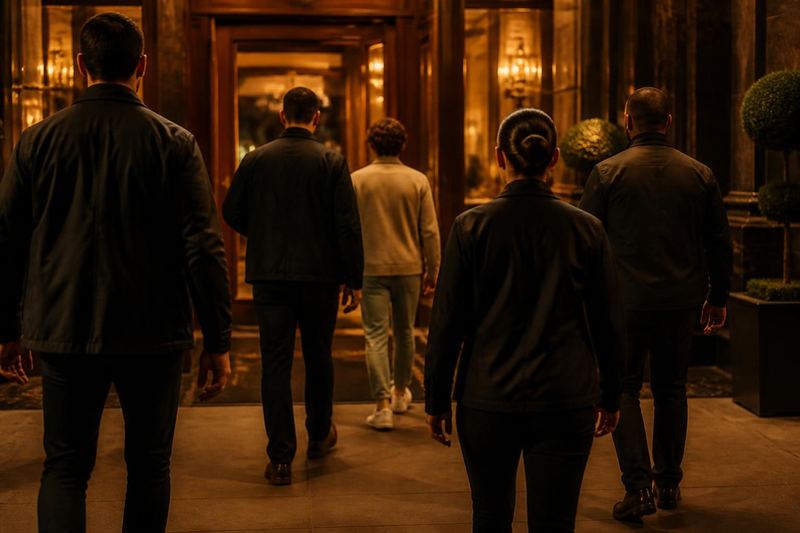
Every profession has its central paradox. Surgeons must cut people to heal them. Lawyers must argue positions they privately doubt. And the close protection operator must be near enough to stop a threat in under two seconds, while remaining far enough away that the client can live something resembling a life.
Too close, and you are a shadow with cologne. Too far, and you are a witness.
Welcome to the Goldilocks zone of executive protection. Not too close. Not too far. And unlike the porridge, the correct answer changes every thirty seconds.
The Kanye Clause
Let us begin with the most famous distance policy in the history of the trade.
Ye, formerly known as Kanye West, has become something of a case study in bodyguard folklore, thanks to his former bodyguard Steve Stanulis, who described a set of what he called "ridiculous rules." Among the highlights, as he tells it: walk ten paces behind on the street, do not speak unless spoken to, and, in one legendary elevator episode, know which floor the client wants without being told, because asking would be a violation. Other celebrity households have reportedly gone further, with staff instructed to avoid eye contact entirely.
Now, from a pure status perspective, this is excellent theater. Nothing says power like a large, serious man trailing you at a respectful distance like a moon in orbit.
From a protection perspective, it is a physics problem with a bad ending. An attacker does not start his approach from ten paces behind the bodyguard. He starts from wherever he is, usually somewhere inconvenient, and he does not pause to let the protection close the gap first. Ten paces is roughly seven meters. Seven meters is well over a full second of sprinting for a fit adult, and that is before the operator has processed what is happening. In this business, a second is not a unit of time. It is the whole event.
And the eye contact rule deserves its own moment of silence. An operator who cannot look around freely is an operator working with the human equivalent of parking sensors disabled. Scanning is the job. The eyes are the first weapon system. Asking a protector to keep his gaze down is like hiring a lifeguard and asking him to please stop watching the water, it makes the guests uncomfortable.
The client is entitled to his rules. The professional is obliged to explain what those rules cost. Which brings us to the delicate art at the heart of this entire profession.
The Non-Negotiables, Delivered Negotiably
Here is the tension nobody puts in the brochure: the operator works for the client, but the operator's advice must sometimes work against the client's preferences.
Every serious protector carries a short private list of non-negotiables. Things like: I must be able to see you. I must be able to reach you. I must know where we are going before we go there. If something happens, you do what I say for the next sixty seconds, and we can discuss my tone afterwards, over a beverage, in a secure location.
The list is short because it has to be. An operator with forty non-negotiables is not a protector, he is a hostage-taker with a retainer. The skill is defending the short list firmly while conceding almost everything else gracefully. The client wants to sit by the window? Fine, the operator repositions. The client wants to skip the planned route and walk through the market? Fine, the operator adapts and quietly ages three years.
But when a preference collides with a true non-negotiable, the professional must say so. Diplomatically, privately, and once. Not in front of the dinner guests. Not with a lecture. A quiet word, a clear reason, and then the client decides, because the client always decides. The operator's job is to make sure the decision is an informed one. If the client overrules him, that goes in writing, not out of pettiness, but because memory is short and liability is long.
The best in this business sound less like drill sergeants and more like good diplomats: they can tell you "no" in a way that feels like a favor.
The Family Man Problem
Now for the most underrated skill in close protection, and it has nothing to do with tactics.
Consider the client who is also a father. At the office he is the decision-maker. At home he is Dad: the one who fixes things, decides things, and stands between his family and the world. That role is his identity. And then a protection detail arrives, and suddenly there is another capable figure in the room, telling everyone where to stand.
Handled carelessly, this is a quiet catastrophe. Every instruction the operator gives in front of the family is a small transfer of authority away from the father. Brief him at the dinner table like a subordinate, and you have not made him safer. You have made him smaller in front of the people whose respect he cares about most. No man forgives that, and no contract survives it.
The wise operator understands that he is not there to replace the protector of the family. He is there to reinforce him. So the briefing happens privately, before, in the car, in the hallway, never mid-scene. In front of the family, suggestions are framed so that Dad announces them: "Sir, whenever you're ready" rather than "We're leaving now." The father says "we're leaving," the family moves, and the operator has achieved the desired outcome while remaining, to all appearances, furniture with situational awareness.
This is not manipulation. It is the deepest form of service. The client hired protection so his family could feel safe. A family that watches its father get managed does not feel safe. A family that watches its father lead, quietly supported by a professional who carries part of the invisible load, feels safest of all. The operator absorbs the logistics, the vigilance, and the worry, and hands back the one thing money is actually trying to buy: a normal evening.
The Verdict
Distance, in the end, is not measured in paces. It is measured in judgment.
Close enough to act, far enough to let life happen. Firm enough to hold the line on the things that matter, flexible enough to bend on everything else. Present enough to protect, invisible enough to preserve the client's standing in his own story.
The amateur thinks the job is standing next to someone important. The professional knows the job is standing exactly where he needs to be, which is a spot that moves constantly and is never marked on the floor.
Not too close. Not too far. And never, ever ten paces behind.
The operator who reads this from the correct distance already knows.
Position Yourself for the Right Detail
580+ close protection positions across 40+ countries. Find the contract that fits.
Get Access →