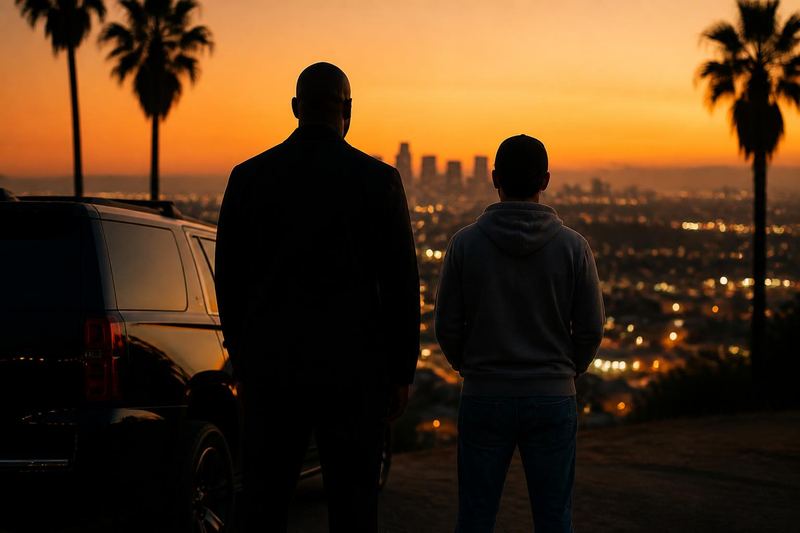
The Birth of the One-Man Army
Somewhere out there, right now, a client is telling his assistant: "I don't need a whole team. Just get me one guy. A really good one. Like in the movies."
And so the One-Man Army is born. One operator. One suit. He is the advance team, the close protection officer, sometimes the driver, the medic, the intelligence analyst, and, during quiet moments, the OSINT department, monitoring open sources, social media chatter, and local news from a corner table in the hotel lobby.
Let's talk about him.
The Job Description Nobody Read Out Loud
On paper, the solo bodyguard does "close protection." In reality, his day looks like this: he wakes up at 05:00 to check the route. He is the route check. He then checks the vehicle. He is the vehicle check. Unless the client uses a limousine or car service, in which case he verifies the car and the driver before every single ride, because a driver who can actually drive smoothly and communicate is one of the rarest creatures in the industry. When he finds one, he guards that phone number like a state secret. He conducts the security advance at the restaurant, which, since he can never leave the client's side, means he did it hours earlier, or by phone with the maître d', or it happens in the same two seconds he clears the doorway at the client's shoulder. The advance team arrives exactly when the client does, because the advance team is standing next to him.
Then he stands post for fourteen hours, retreats to his hotel room (strategically booked as close to the client as possible, ideally the same floor), writes his own after-action report to himself, approves it himself, files it himself, and goes to sleep with one eye open, because the night shift is also him.
Is it sustainable? Of course it is. In the same way that a candle burning at both ends is sustainable. Briefly, and with a lovely glow.
Fatigue is the quiet enemy of protection work. Vigilance is a muscle, and no muscle holds a flex for sixteen hours. A tired operator doesn't stop caring. He just starts seeing the world in soft focus, and soft focus is a terrible setting for threat identification.
And here's what the brochures don't mention: a client who actually lets you eat or rest is not a given. Some do. Some consider your lunch a scheduling error. Add to that the client's mood, which can swing like a market index, and the solo operator has no colleague to trade eye-rolls with. He absorbs it alone. Running on four hours of sleep, he may still catch undeserved criticism for something entirely outside his control. Should he speak up? Sometimes he must. A professional who never pushes back isn't a professional, he's furniture. But other times the job is knowing which battles to fight and which to swallow whole, keep a straight face, and get back to watching the door.
The Math Problem in the Middle of the Profession
Here is the puzzle at the heart of the one-man detail, and it deserves to be said plainly:
If the bodyguard engages the threat, who is with the client? Nobody. That's who. The entire protective bubble just sprinted in the other direction.
Protection doctrine is beautifully simple on this point: someone covers and evacuates the principal, and someone else deals with the problem. Those are two different jobs, happening in two different directions, at the same time. A solo operator has to choose, and the correct choice, by the book, is to grab the client and leave. Which means the one-man army's actual combat role is best described as "one-man organized retreat."
That's not cowardice; that's the job. But it does mean the "army" in One-Man Army is doing a lot of heavy lifting, marketing-wise.
With a two-man detail, one covers, one moves. With a proper team, you get overlapping arcs, an advance element, and, luxury of luxuries, someone who has slept.
And Yet, The Client Decides
Now, before every solo operator in the industry sends me a strongly worded voice memo: none of this is a dig at the professionals doing this work alone. Many of them are outstanding. They perform tactical miracles of scheduling and stamina every single week, and still manage flawless social etiquette when the client attends a dinner party or gala. Because at that level, the bodyguard gets talked to. A senior partner will wander over with a glass of wine and an opinion about the markets, and the operator must hold polite, charming conversation while simultaneously tracking every entrance, exit, and waiter in the room. Diplomat on the surface, radar underneath.
Because here's the truth of the trade: the client decides. How many operators, what budget, what profile. The threat assessment can recommend a four-man detail with an advance car; the client can look at the invoice and say, "Let's start with one. Preferably one who also plays golf."
The professional's job is to give an honest assessment, explain what one person can and cannot do, and then deliver the best possible protection within what the client chooses. A good solo operator is upfront about the trade-offs. A great one puts them in writing.
One is infinitely better than zero. It just isn't four.
The Luggage Question
Which brings us to the most dangerous topic in executive protection. Not firearms. Not route planning. Bags.
"Could you just grab those?"
Here's the thing: most operators don't carry the client's bags, and it's not arrogance, it's arithmetic. A protector's hands are part of the equipment. Hands occupied by a garment bag, a duty-free carrier, and a small confused dog are hands that cannot react. The industry phrase is "hands free at all times," which sounds like a headset advertisement but is actually a survival principle.
The solo operator faces this dilemma at its purest. There is no junior team member to hand the luggage to. There is no luggage guy. He is the luggage guy, the door guy, the car guy, and the guy-watching-the-crowd guy, with only two hands to distribute among four jobs.
So when a professional politely declines to carry the shopping, he isn't being difficult. He is, quite literally, keeping his hands free to do the one thing he was hired for. The porter carries bags. The bodyguard carries responsibility.
(And a trauma kit. Someone has to.)
The Verdict
The One-Man Army is real, he is out there, and he is doing his best, running on espresso, threat assessments, and the unshakeable confidence of a man who has been his own quick-reaction force since 2019.
Respect him. Hire him. And if you can, hire him a colleague.
Because even a one-man army deserves a lunch break. And your protection deserves someone standing post while he takes it.
No solo operators were harmed in the writing of this article.
Find Your Next Detail
580+ close protection positions across 40+ countries. Solo or team — we've got the contracts.
Get Access →