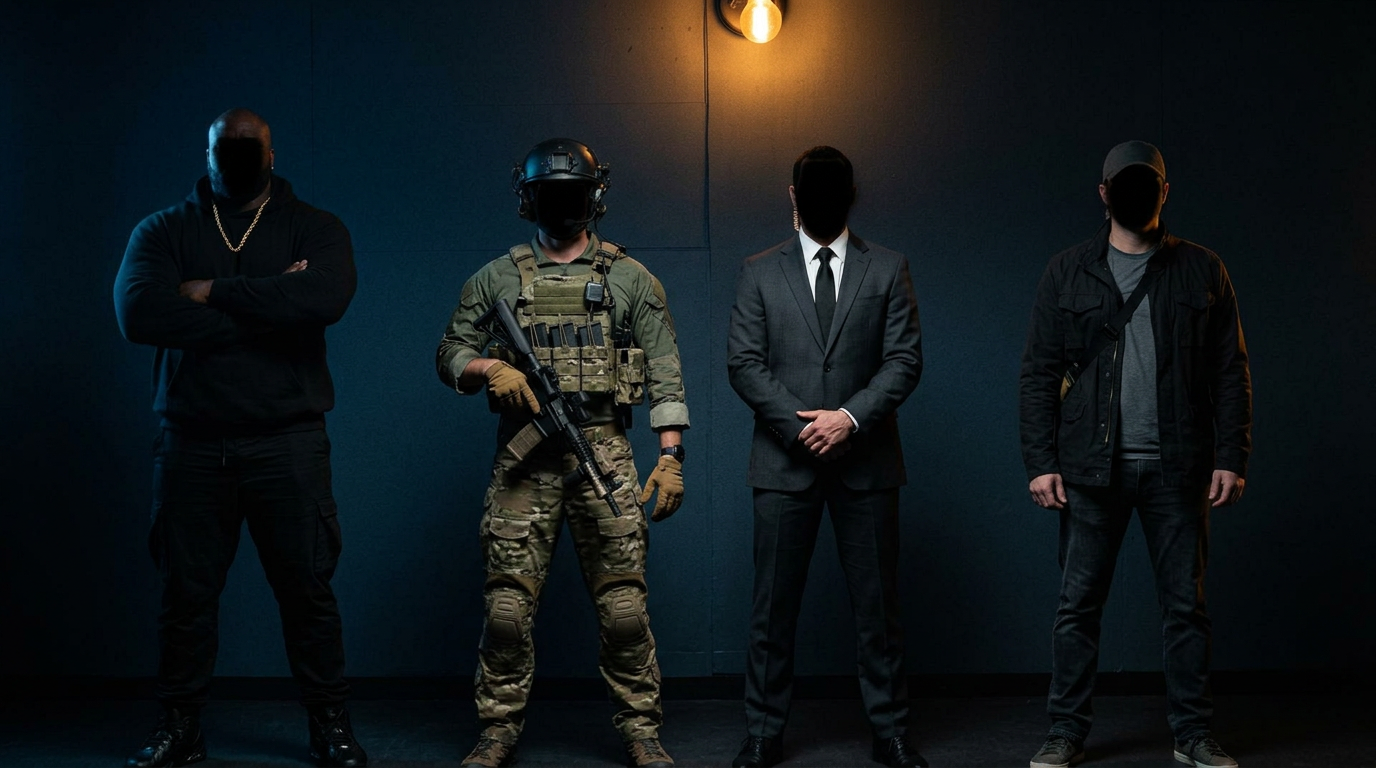
Should a Bodyguard Be Big?
It depends. And the fact that the answer isn't obvious tells you something about the industry.
Does a 6'4, 120-kilo operator blend in at a private gallery opening in Chelsea? At a school pickup? At an intimate dinner in a Michelin restaurant in Paris? Probably not. But does that same operator command a red carpet arrival, keep a crowd at arm's length during a premiere, or project enough authority that nobody in the club tests boundaries? Absolutely.
So which matters more — blending in or standing out? That depends entirely on the principal and the context. A tech CEO who values privacy above all else doesn't want a walking neon sign next to them at brunch. But a celebrity walking into Cannes wants the optics. The entourage is part of the image. The imposing figure in the tailored suit next to them on the red carpet says something — about status, about importance, about the fact that this person matters enough to be protected.
Both are valid. Both are professional. The question isn't "should a bodyguard be big?" — it's "what does this principal need in this environment?" The best teams don't have a type. They match the operator to the situation. A 5'9 grey man for the school run. A 6'3 presence for the awards ceremony. Sometimes both on the same detail, same day.
The Stereotypes (And What's True About Them)
The Military Hard-Charger
Former infantry or special forces. Exceptional under pressure. Can execute any instruction instantly. Moves with purpose. Physically capable of handling almost any threat scenario.
But here's the question nobody asks in the interview: can he sit through a four-course dinner without looking uncomfortable? Can he make small talk with the principal's wife? Does he know which glass is for water and which is for wine? Can he walk into a room full of people who earn more in a month than he earns in a year and not feel — or look — out of place?
The military produces incredible operators. It does not produce people who are naturally comfortable in environments where the dress code is "cocktail attire" and the small talk is about art acquisitions. Some make the transition effortlessly. Many struggle with it more than they'd ever admit.
The PMC Crossover
Private military contractor experience. Worked hostile environments — Iraq, Afghanistan, parts of Africa. Outstanding operational awareness, threat assessment, team coordination under fire.
The gap is etiquette. Not manners in the basic sense — but the behavioral code of high-net-worth environments. PMC work rewards directness, aggression, and visible authority. Executive protection rewards the opposite: subtlety, deference, and the ability to exercise authority without anyone noticing you have it.
A PMC operator who tells a principal "You can't go there, it's not safe" might be correct. But the operator who says "I'd suggest we take a different route — it'll be quicker and more comfortable" delivers the same outcome without making the principal feel controlled. That distinction is everything in this market.
The Grey Man
Average height. Average build. Forgettable face. Looks like an accountant, a PA, a friend of the family. Nobody gives them a second glance.
This is increasingly the most sought-after profile in UHNW protection. Principals don't want to look like they have security. They want to look normal. The grey man provides protection without the optics. They can sit in a restaurant, walk through an airport, attend a school event — and nobody in the room thinks "bodyguard."
The trade-off? If a physical confrontation happens, they may not have the same deterrent effect as someone who looks like they bench-press Ferraris. But the calculation most clients make is: the probability of needing visible intimidation is low; the probability of wanting to feel normal in public is 100%.
The Medic-First Operator
This is the profile nobody talks about — but should. A CPO with a strong medical background: paramedic, combat medic, FREC 4+, trauma-qualified.
Ask this question: what's more likely to threaten your principal's life — an attack, or a cardiac event? A stalker, or an allergic reaction at 35,000 feet? A kidnapping attempt, or a fall down a staircase at the estate?
For principals who are elderly, have chronic conditions, travel with young children, or simply live the kind of high-stress life that makes them statistically more vulnerable to medical events — a medic-first CPO isn't just useful, they're potentially the most important person in the household.
An 80-year-old billionaire doesn't need someone who can clear a room tactically. He needs someone who can recognize the signs of a stroke, keep him alive for 12 minutes until the ambulance arrives, and knows which hospital within a 30-minute radius has the best cardiac unit. That's a different skill set entirely.
"I've been on details for 15 years. I've used my medical training nine times. I've used my tactical training in a real situation exactly zero times. Draw your own conclusions."
The Etiquette Problem Nobody Wants to Discuss
There's an unspoken tension in the industry between operational capability and social polish. The operators who can handle the most dangerous situations are often the ones who are least comfortable at a gala dinner. And the operators who navigate high-society environments effortlessly may never have been tested under real pressure.
The industry pretends this tension doesn't exist. It does.
A principal hosting a dinner party for foreign diplomats needs their CPO to look like they belong at the event — not like they're guarding it. That means understanding dress codes, table manners, conversational boundaries, cultural sensitivities. Knowing when to be invisible and when to be present. Reading the social dynamics of a room as carefully as you'd read its tactical layout.
For operators coming from military or PMC backgrounds, this can feel trivial — even demeaning. But it's not optional. The principal who feels embarrassed by their security in a social setting will replace that security. It doesn't matter how good you are operationally if you make the principal's guests uncomfortable.
And Then There's Networking
Everything above compounds when it comes to building your career. Because close protection is a referral industry — and referrals happen in social contexts.
The operator who can work a room at an industry conference, hold a conversation with a client's estate manager, impress a family office security director over coffee — that operator builds a network. The one who stands in the corner radiating tactical competence but can't make small talk doesn't. It's not fair. It's just how it works.
Networking in EP isn't LinkedIn messages. It's being someone people want to call again. And "want to call again" is a social judgment as much as a professional one.
So What Type of CPO Should You Be?
The honest answer: it depends on where you want to work.
- Hostile environments? Operational capability dominates. Social polish matters less when the environment is a mine in West Africa.
- Celebrity/entertainment? Physical presence helps. You need to handle crowds, paparazzi, and chaotic public environments. But you also need to be comfortable around creative people who don't respect authority hierarchies.
- UHNW residential? Social skills are paramount. You're in the principal's home, around their family, their guests. This is where etiquette makes or breaks careers.
- Corporate? Professionalism and process. The ability to operate within corporate structures, write reports, coordinate with multiple stakeholders.
- Elderly or medical principals? Medical qualifications may be more valuable than any tactical background. This is an underserved niche with growing demand.
The operators who build the longest careers aren't the ones who master one type. They're the ones who are honest about their gaps and work to close them. The commando who takes an etiquette course. The medic who trains in defensive driving. The grey man who maintains physical fitness that nobody would expect from looking at him.
The best CPO isn't a type. It's someone who can be the right type for the detail they're on.
Find the Right Detail for You
580+ positions across every specialization — hostile, residential, corporate, entertainment, medical.
Browse Positions →